Knowledge about non-binary gender – since 2016
Introduction to the topic of non-binary gender and links for further reading:
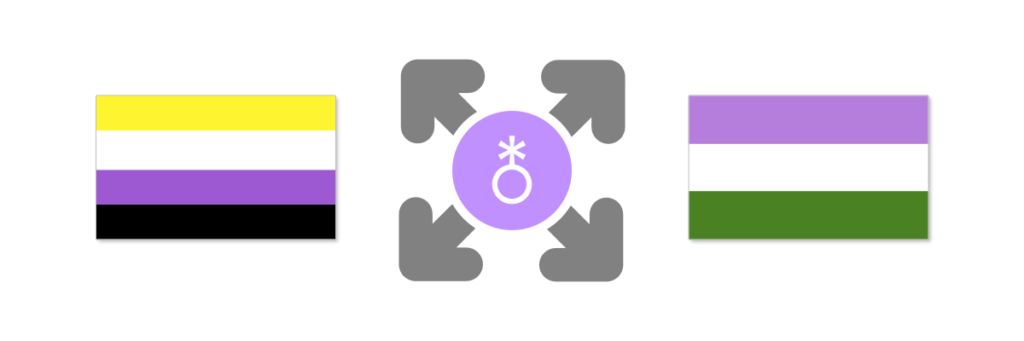
IN SHORT: Non-binary people do not identify, or only partially identify, with either of the two binary genders, “woman” or “man”. Since “non-binary” (shortened to “enby”) also serves as an umbrella term for various expressions of gender, the term can have very different specific meanings: Some enbies have no connection to the concept of “gender” at all; some experience their gender as a blend of femininity and masculinity or even of other genders; some others have a sense of gender that changes over time, and so on. Non-binary gender only says something about a person’s gender identity, and nothing about bodily characteristics, appearance, sexual orientation, or gender roles.
What is Non-Binary Gender?
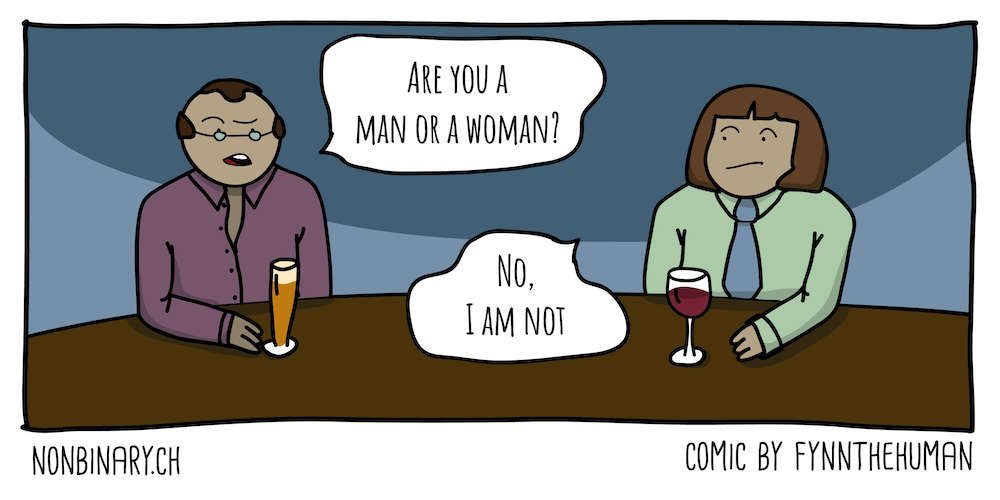
Non-binary people do not identify with the categories “woman” or “man”. Some may present in an androgynous way, but appearance never determines non-binary identity.
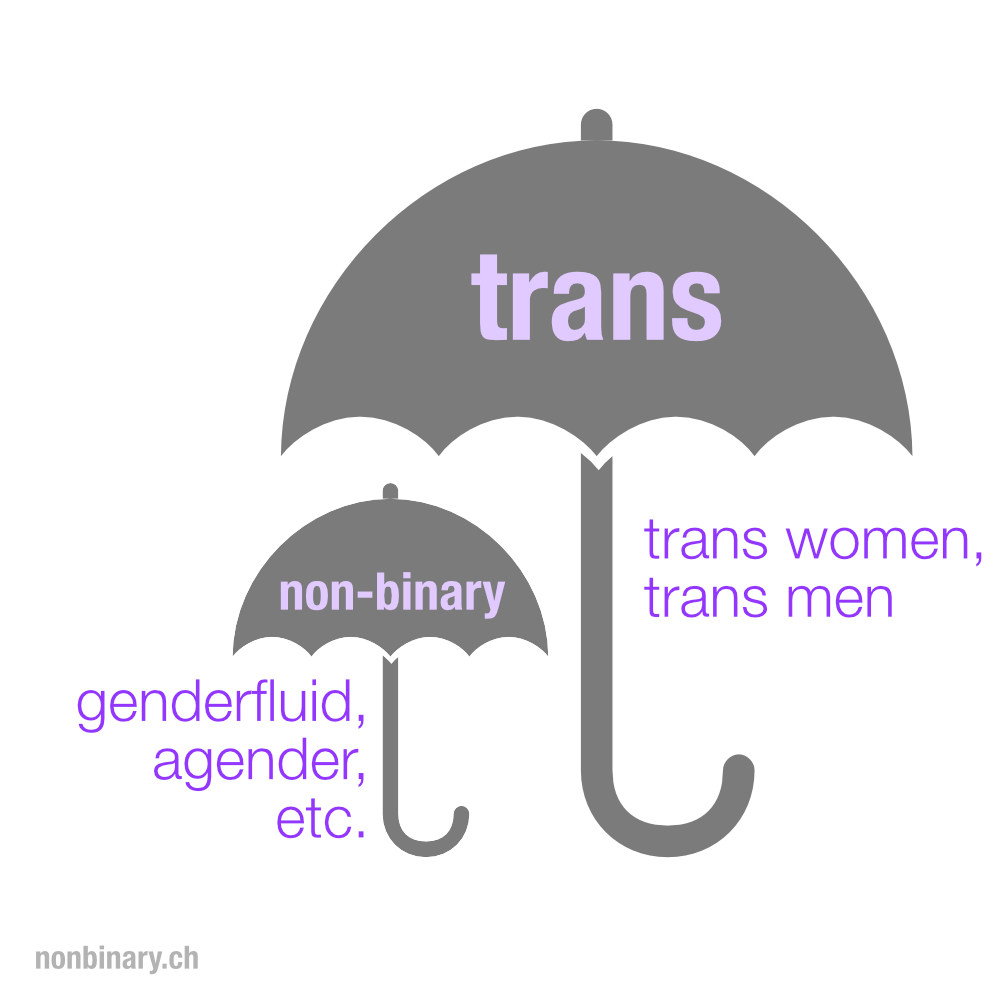
According to the definition of trans identity, non-binary people are also trans, but not all of them identify that way. Non-binary is an umbrella term that encompasses many gender identities, such as genderfluid, agender, bigender, neutrois, genderfree, demigender, etc.
Links:
- Information:
- Website: Nonbinary Wiki
- Book: Beyond the Gender Binary, 2020, Alok Vaid-Menon
- Book: Genderqueer and non-binary genders, 2017, ed. Richard
- Book: Life Isn’t Binary, 2019, Barker & Iantaffi
- Paper: Non-binary or genderqueer genders, 2016, Richards, Bouman, Seal, Barker, Nieder, T’Sjoen
- Education:
- Geschlechter-Radar Bildungsangebote (also in English)
- Organizations :
- Transgender Network Switzerland [de]
- TGEU (Trans Europe and Central Asia)
- Ekivock [fr] – Association pour les personnes non-binaires de la Suisse romande
- Asso trans&non-binär [fr] – association par et pour les personnes transgenres, non-binaires et en questionnement, dans le canton de Fribourg
It is Important to Understand Sex & Gender as a Whole
Sex & gender have several dimensions: body, identity, expression, attraction, roles.
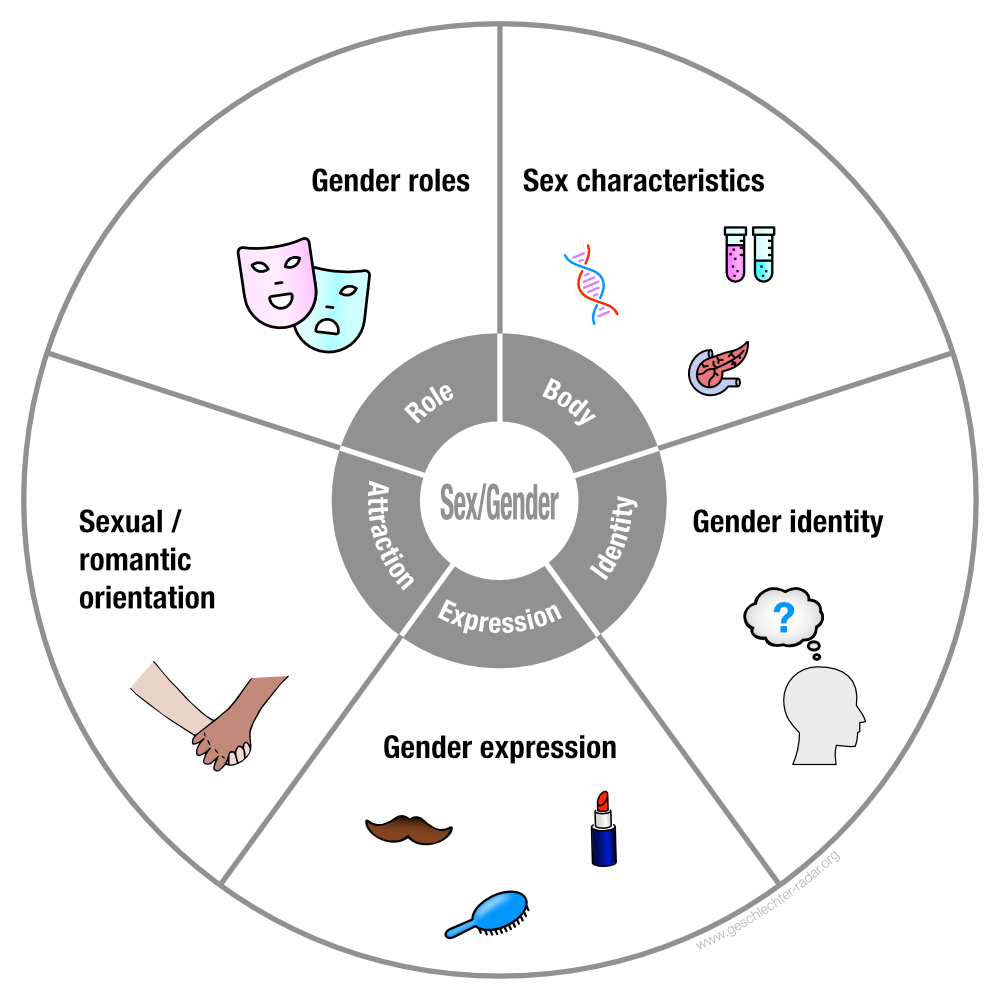
Non-binary gender refers solely to gender identity. It is not related to bodily appearance or sexual orientation.
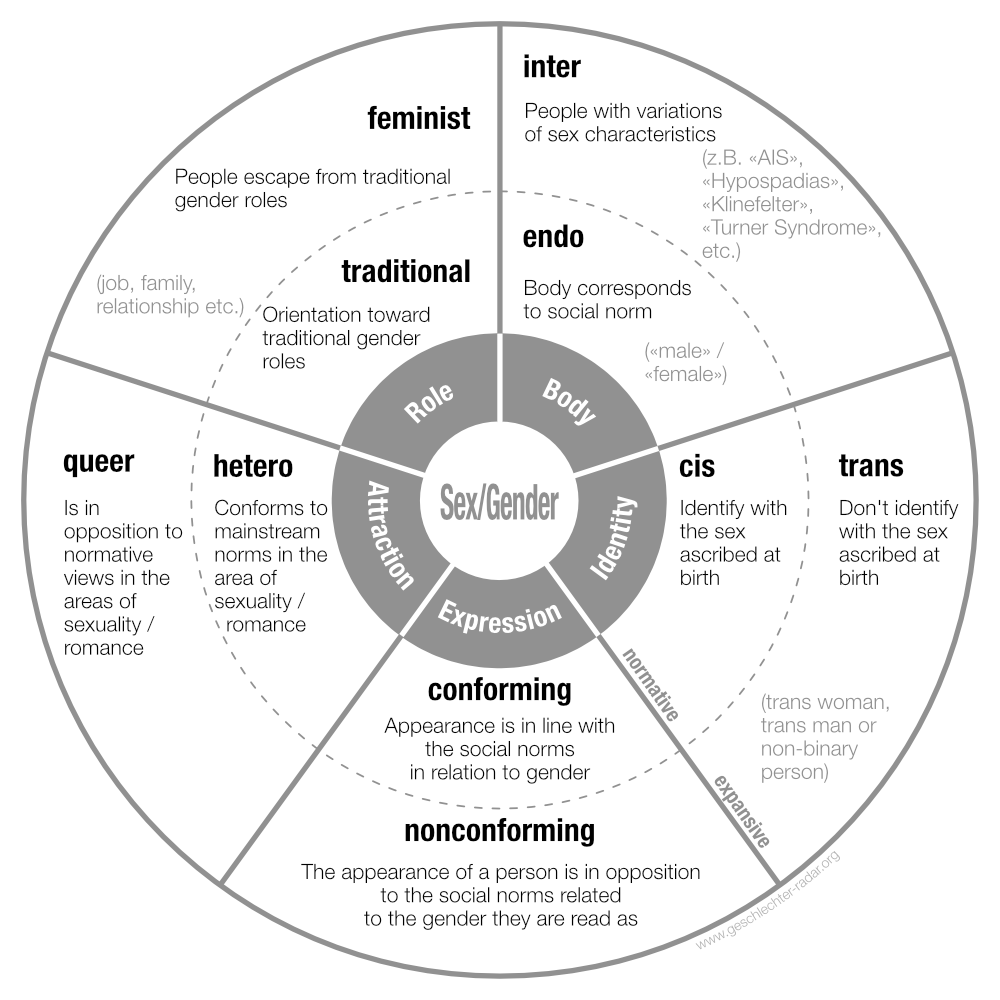
Non-binary gender is distinct from intersex, which refers to bodily characteristics. Intersex people may have a variety of gender identities, including non-binary ones. In Switzerland today, intersex babies are still victims of human rights violations!
Links:
- Sex & Gender Radar (Geschlechter-Radar, CH)
- InterAction Suisse [fr] – Association suisse pour les personnes intersexes
Traditional Cultures
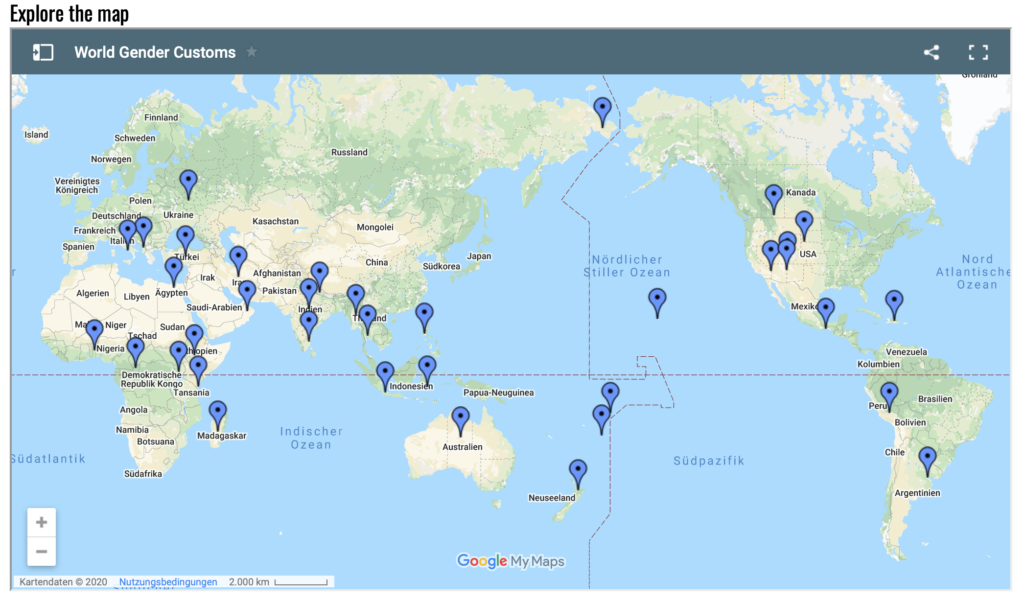
However, “non-binary or trans identities” exist in many cultures around the world and are not a new phenomenon. These traditional cultures recognize more than two genders.
Links:
- Text: A Map of Gender-Diverse Cultures (Independent Lens, 2023)
- Video: Two Genders? What History Tells Us About Gender & Identity (16:26 min. en, DW History and Culture, 2025)
- Website: Lei Pua ʻAla – queer histories of Hawaiʻi
- Website: The Healer Stones of Kapaemahu [Hawaiʻi]
- Text: Beyond Gender: Indigenous Perspectives, Fa’afafine and Fa’afatama (Natural History Museum Los Angeles County, 2020)
- Video: Fa’afafine: Samoan Boys Raised As Girls (10:12 min. video)
- Text: Asia’s isle of five separate genders (BBC, 2021) [Indonesia]
- Text: The Third Sex (Talia Bhatt auf Substack, 2024) [India]
- Video: Transgender in Pakistan | DW Documentary (12:25 min., 2023)
- Video: Two Spirit People [22.51 min., USA, 2019]
- Journal: Two Spirit Journal [United States and Canada]
- Text: The muxe, Mexico’s ‚third gender‘, are part of a worldwide LGBTQ+ movement (Los Angeles Times, 2024)

The Realities of Life for Non-Binary People
Since Swiss society still adheres to a rigid binary gender system in many areas, non-binary people face discrimination on various levels – particularly in language, infrastructure (restrooms, changing rooms, forms, etc.), and the lack of legal recognition.
This lack of recognition can render non-binary people invisible or ignored in certain institutional settings. In Switzerland, it is estimated that there are approximately 103,000 to 154,000 non-binary people.
Links:
- NEK veröffentlicht Stellungnahme zur amtlichen Registrierung des Geschlechts [de] (National Advisory Commission on Biomedical Ethics, 2020)
- Bundesrat macht Anliegen der nicht binären Personen sichtbar [de] (Federal Council, 2025)
- Broschure: Was gilt? LGBTI – meine Rechte [2nd Ed., de]
Communication
How to include non-binary people in language?
Inclusive writing
English already has fewer gendered word endings than other languages, so inclusive writing focuses more on avoiding unnecessarily gendered language.
Examples:
- chairperson (instead of chairman/chairwoman)
- firefighter (instead of fireman)
- server (instead of waiter/waitress)
- police officer (instead of policeman/policewoman)
Neutral formulations:
- participants
- everyone
- the team, the staff, the group, etc.
Pronouns
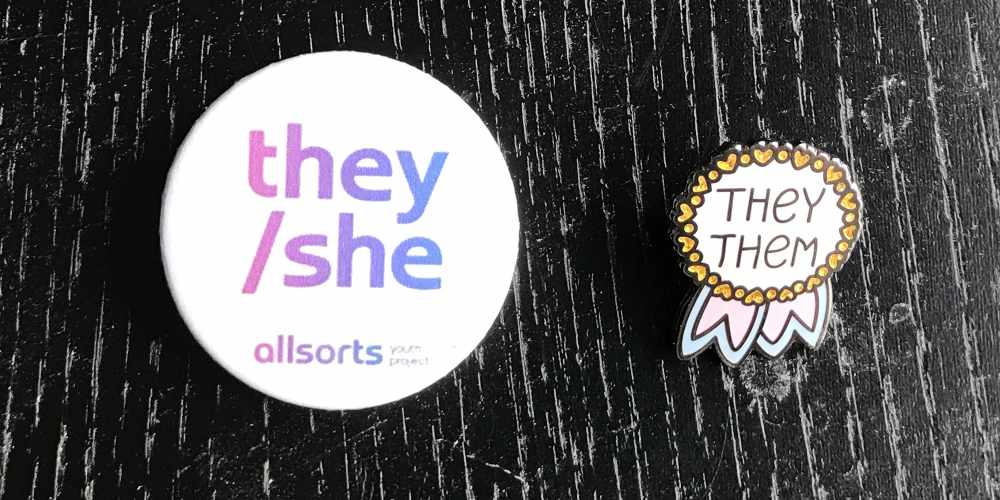
Singular “they” is now widely used in English and accepted in many contexts. But some people use other or no pronouns at all.
Some people use …
- they pronouns
- neopronouns: ze/zir, xe/xem, ey/em, etc.
- no pronouns (using the person’s name instead)
- binary pronouns (“he” or “she”)
It is also possible to rephrase:
- “the person in the red sweater”
- “the person who spoke earlier”
Terms for people
Neutral terms:
- child (instead of son/daughter)
- person
- specialist
- colleague
- doctor
Other neutral job titles:
- teacher
- cook / chef
- author
Neutral constructions:
- team member
- person responsible
- contact person
- support person
Greetings
A first and last name can replace gendered titles such as “Mr.” or “Ms.”. In English there is also the neutral title “Mx.” (pronounced “mix”).
For one person:
- Hello Kim Smith
- Good evening Sasha Brown
Letter / e-mail:
- Hello Kim Wilson
- Dear Sasha Taylor
For a group:
- Hello everyone
- Dear guests
- Dear attendees
- Hey folks
Also important in personal interactions
- Avoid making assumptions about a person’s gender
- Respect the identities and wishes of non-binary people
- There is no single “correct way” to be non-binary
- Ask for a person’s name, pronouns, and preferred form of address
- When introducing yourself, also share your own pronouns
Links:
- Website: Pronouns.page
- Website: singularthey.info
- Website: mypronouns.org (von Shige Sakurai) resources on personal pronouns
- Article: What People Get Wrong About They/Them Pronouns (Wren Sanders, 2019, them)
- Article: Understanding Neopronouns (The Human Rights Campaign, 2022)
- Audio: They/Them and the evolution of English [12 min.] (2024, TED Radio Hour, npr)
Signage
Gender-neutral restrooms can be identified by pictograms that illustrate their equipment.
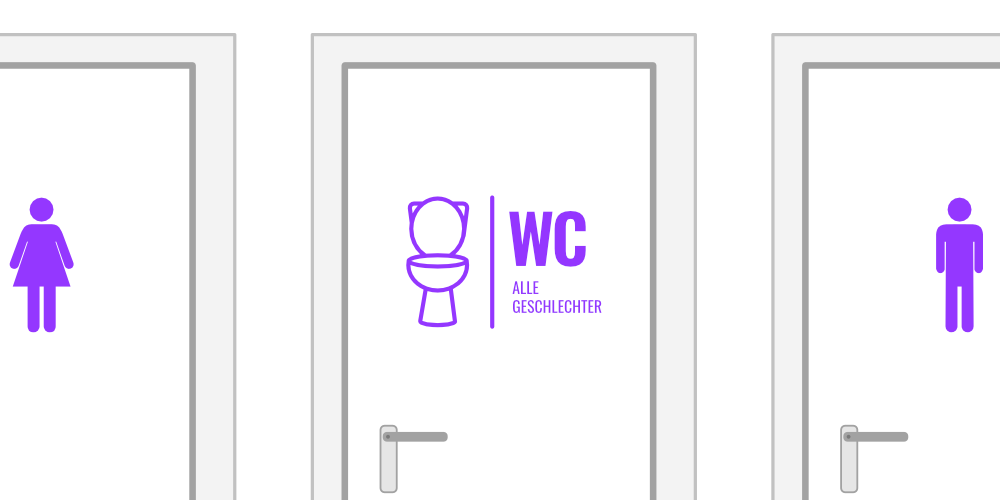
More about signage: Signaletik [de]
(Download: Temporary Signs as PDF [de, en])
Forms
Including non-binary individuals in forms:
Questions to ask:
- Do I really need this information?
- If in doubt, don’t ask for it!
- Do I need to know the genre or the title?
Gender:
☐ Woman ☐ Man ☐ _________
☐ Woman ☐ Man ☐ Non-binary
☐ Woman ☐ Man ☐ Another gender
Honorifics:
☐ Ms. ☐ Mr. ☐ Neutral form of address
☐ Ms. ☐ Mr. ☐ Mx.
Pronouns: ☐ She ☐ He ☐ They ☐ _____
Links:
- More about forms: Formulare [de]
- Designing forms for gender diversity and inclusion (Sabrina Fonseca, 2017, auf UX Collective)
- Monitoring equality: Developing a gender identity question [PDF, 182 S.] (Balarajan, Gray & Mitchell, 2011, Equality and Human Rights Commission, Research report 75)
- Code & Resources: Beyond Binary Code (von Spark, New Zealand)
Fact Sheet
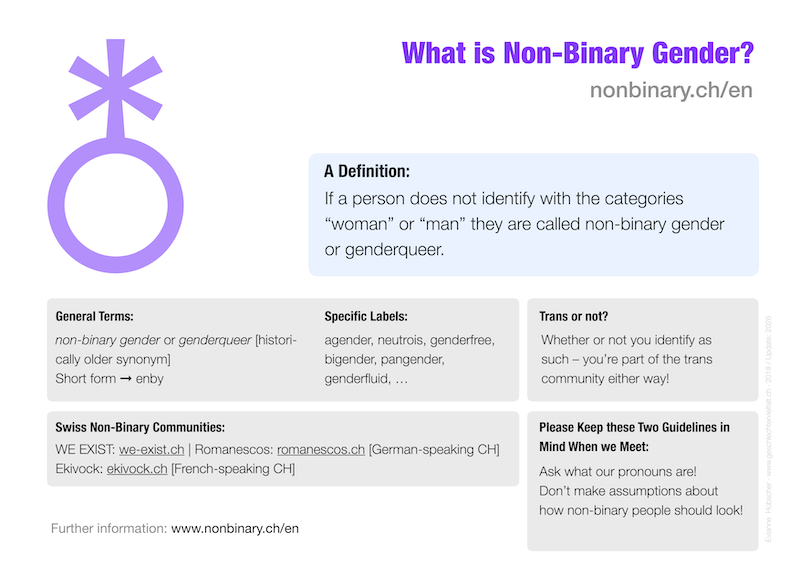
Information on the question “What is non-binary gender?” on an A4 sheet
Fact sheet [PDF]
Learn More – in German
This website offers a wide range of resources on non-binary gender in German. You can navigate the site using the menu, the site map, or the search function. Stay up to date with the latest information via the newsletter. The blog features articles on various topics and year-in-review posts about non-binary gender.
Do you have questions or feedback? Contact form
Text von: Evianne Hübscher
Erste Veröffentlichung: 1.6.2026 | Letztes Update: 1.6.2026